
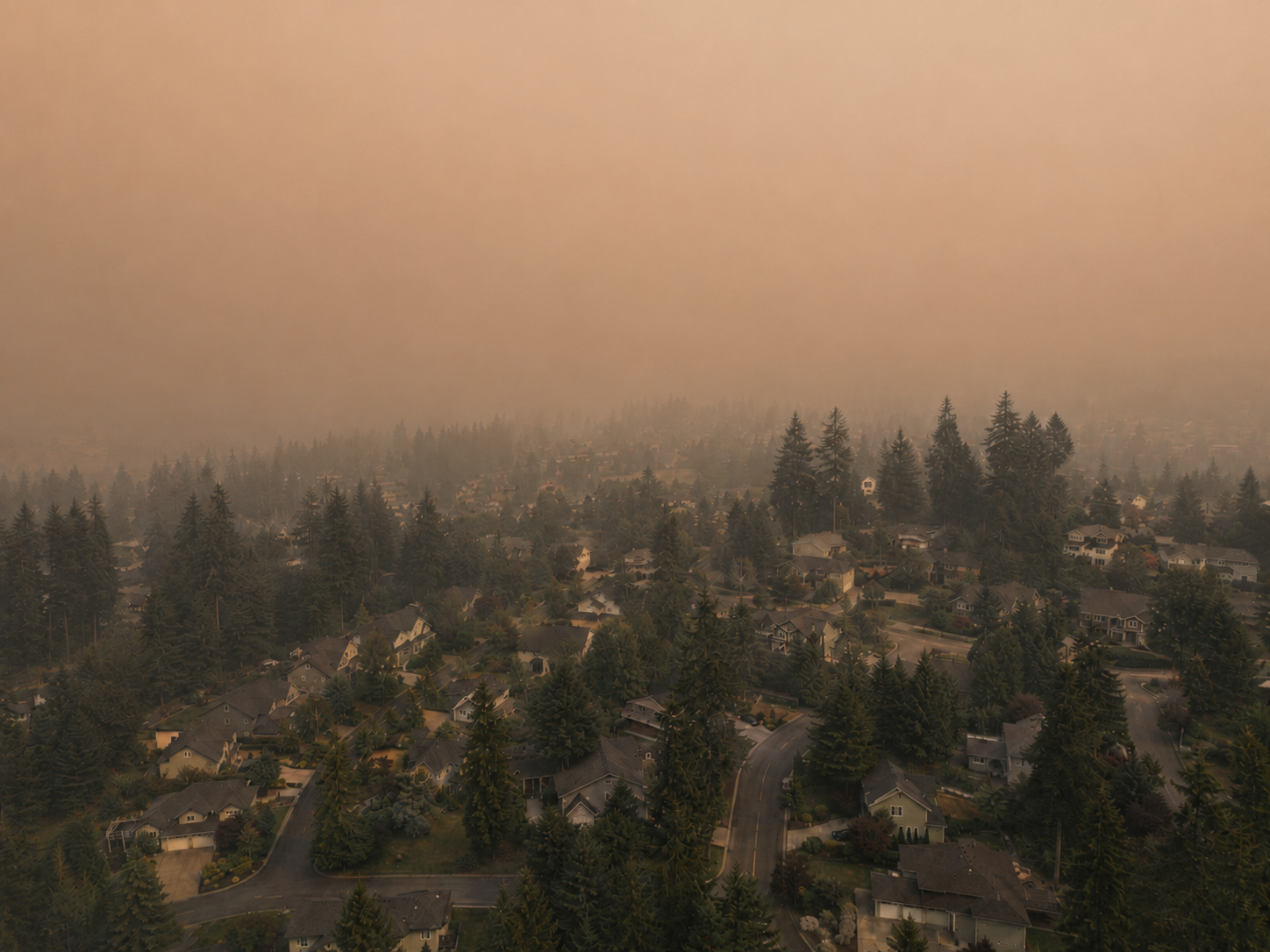
By late summer, wildfire smoke can feel like Washington’s fifth season. Conditions can change quickly and vary from one town, valley or neighborhood to the next. A simple routine can help: check the air near you, reduce your exposure when it worsens and get care when respiratory symptoms aren’t settling down.
Why Wildfire Smoke Affects Your Health
Wildfire smoke contains fine particles known as PM2.5. These particles are small enough to travel deep into the lungs. Exposure can cause irritated eyes and throat, headaches, coughing, wheezing, shortness of breath, chest tightness and fatigue. It can also make asthma, COPD and heart conditions worse.
Washington State Department of Health advises everyone to reduce smoke exposure. Children, older adults, pregnant people and people with heart or lung conditions should take extra care.
Check the Air Where You Actually Are
Start with the Washington Smoke Blog Monitoring and Forecasting page. It brings together Washington smoke forecasts, current conditions, local Smoke Outlooks and several forecasting tools.
Use the forecast to plan the next few days. For a decision about a walk, outdoor job, practice or open window, check the AirNow Fire and Smoke Map immediately beforehand.
Search for your address, city or ZIP code and look for a monitor or sensor close to where you’ll actually be. Click a circle to see its current Air Quality Index, recent trend and recommended precautions. Check two or three nearby readings when possible. A sensor across a ridge, at a different elevation or in another valley may not represent your neighborhood.
| AQI | What It Means | What to Do |
|---|---|---|
| 0 to 100 | Good to moderate | Most people can continue normal activities. People who are sensitive to smoke should monitor symptoms. |
| 101 to 150 | Unhealthy for sensitive groups | Children, older adults, pregnant people and people with heart or lung conditions should reduce prolonged or strenuous outdoor activity. |
| 151 to 200 | Unhealthy | Everyone should reduce extended outdoor exertion. Sensitive groups should move activities indoors. |
| 201 or higher | Very unhealthy to hazardous | Avoid unnecessary outdoor exposure and spend time in cleaner, filtered indoor air. |
Why Smoke Forecasts Change
“Forecasting smoke is not like conventional weather forecasting.”
That explanation comes from Washington Department of Ecology atmospheric scientist Ranil Dhammapala. Fires can grow, slow down or begin unexpectedly. Wind, temperature and terrain also determine whether smoke stays overhead, moves away or settles near the ground.
Smoke forecasts are useful planning tools, but they aren’t promises for a particular neighborhood or hour. Use the forecast for the general direction. Use a nearby monitor or sensor for the current decision.
Track Nearby Fires With Watch Duty
Watch Duty is a free nonprofit app that provides real-time wildfire alerts, fire perimeters, evacuation information and verified incident updates in one map. It’s useful for seeing what’s burning nearby and how a fire is changing, while the Washington Smoke Blog and AirNow remain the better tools for health-based air-quality decisions.
Keep local county emergency alerts enabled as well. No single app should be your only source for evacuation instructions.
Create Cleaner Air Indoors
University of Washington smoke expert Elizabeth Gribble Walker has said that having a system to clean indoor air is just as important as having a smoke detector.
- Choose one cleaner-air room. A bedroom or family room with few exterior doors and windows is easier to filter than an entire house.
- Run a portable HEPA air cleaner. Use a unit sized for the room and keep a replacement filter available.
- Use your HVAC system wisely. Set it to recirculate rather than bringing in outdoor air. A MERV-13 filter can capture smoke particles when the system can safely accommodate it.
- Reduce indoor particle sources. Avoid candles, incense, smoking, wood burning, aerosol sprays and heavy frying during smoky periods.
- Don’t let the home become dangerously hot. Go to a cooled, filtered public space or another home if closing the windows creates a heat risk.
- Use recirculate in the car. Close the windows and check whether the cabin-air filter needs replacement.
A do-it-yourself air cleaner can help when a portable HEPA unit isn’t available. The EPA recommends a MERV-13 filter, a cardboard shroud and a newer UL- or ETL-certified box fan.
More Smoke-Season Tips
- Morning isn’t always cleaner. Smoke can settle into Washington valleys overnight. Check a current reading before an early walk, run or practice.
- Don’t rely on visibility alone. Smoke may remain high above the ground or mix downward later. The AQI gives you better information than the color of the sky.
- Watch the trend. Delaying an errand or workout for an hour may help when readings are improving.
- Keep N95 respirators accessible. A well-fitting, NIOSH-approved N95 can reduce particle exposure when you must be outside.
- Ask about your workplace plan. Washington has specific wildfire-smoke protections for outdoor workers.
When Smoke Starts Affecting Your Breathing
Move into cleaner air and reduce physical activity if you develop eye or throat irritation, coughing, wheezing, chest tightness or shortness of breath. Contact a clinician when symptoms persist, your asthma or COPD symptoms are getting worse, or your usual treatment isn’t working as expected.
Start With Nice Healthcare
Eligible employees and dependents enrolled in Nice Healthcare through Business Health Trust can use Nice for same-day primary care. A Nice clinician can evaluate coughing, wheezing, chest tightness, asthma concerns and other symptoms that may be affected by smoke. They can also review your current treatment plan, provide refills or prescribe treatment when appropriate and help decide whether you need in-person or higher-level care.
Nice covers more than 550 common medications at $0 when prescribed by a Nice clinician. As of July 2026, the list included several common respiratory medications. You can see examples in this guide to Nice’s $0 medications. The list may change.
Nice can also prescribe medications that aren’t on the $0 list. Those prescriptions can be sent to your pharmacy or delivered to your door and processed through your regular health insurance, with the plan’s normal copay or deductible.
Call 911 for severe trouble breathing, chest pain or another medical emergency.
Get Ready Before the Next Smoky Day
- Bookmark the Washington Smoke Blog and AirNow Fire and Smoke Map.
- Install Watch Duty and turn on local emergency alerts.
- Identify useful monitors or sensors near home, work and school.
- Set up one cleaner-air room and check your filter supply.
- Keep N95 respirators where they’re easy to reach.
- Refill prescribed asthma or respiratory medications before they run out.
- Create your Nice account before you need an appointment.
Related Posts

What would other health plans cost for the same employees? And would starting coverage in December instead of … Prepare for Renewal With BHT’s Free Plan Comparison Tool

When health insurance rates jump more than 20%, it’s fair to ask: Who’s checking these numbers, and why … OIC Podcast: Why Health Insurance Rates Keep Rising and Why the State Can’t Just Say No

Starting January 1, 2027, Premera Blue Cross will stop requiring EviCore utilization review for massage therapy. For employees … Premera Removes a Review Step for Massage Therapy in 2027

A high blood pressure reading can leave you with plenty of questions. The same goes for a type … Nice Healthcare’s Specialized Programs: Support That Goes Beyond the First Visit

When you’re fighting a cold, it’s easy to grab a cold-and-flu medicine for your cough and a pain … Your Cold Medicine Might Be Wearing a Disguise

October tends to put a little more candy within reach. Then someone catches a cold, and the cough … Your Teeth Don’t Know It’s a Cough Drop